
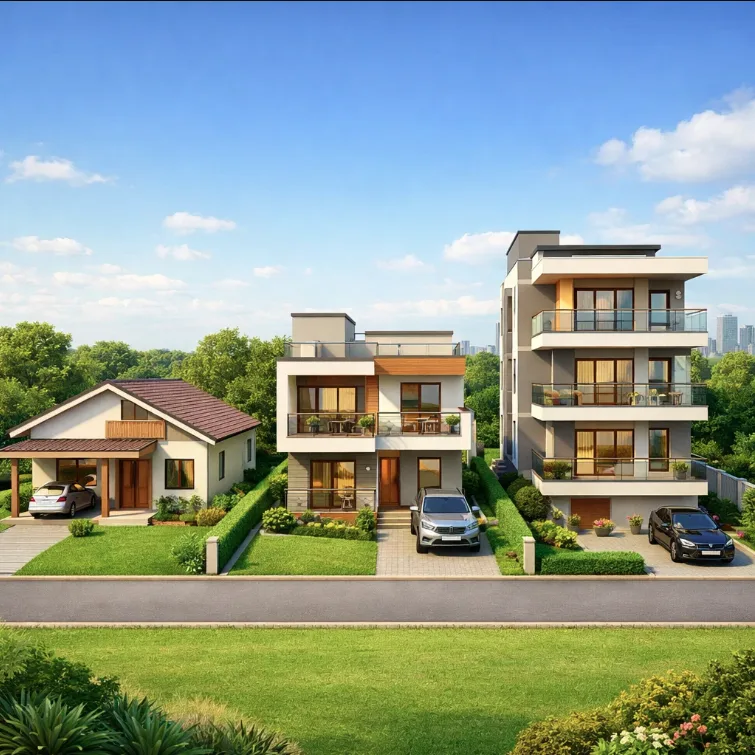
Why Vertical Home Planning Is Evolving in Cities Like Siliguri
With rising land prices, shrinking plot sizes, and increasing demand for rental income, homeowners today are thinking vertical. In growing cities like Siliguri, the question is no longer “Should I build?” but rather “How many floors can I build on my land?”
Choosing between G+1 vs G+2 vs G+3 building is not just a design decision—it impacts your budget, permissions, foundation design, future expansion, and long-term returns. Selecting the ideal number of floors for a residential building requires balancing plot size, FAR rules, structural feasibility, and lifestyle needs.
This guide will help you decide the best house design for your plot size—clearly and practically.
What Is the Ideal Number of Floors for Your Plot Size?
The ideal number of floors depends on plot size, local FAR rules, structural design, budget, and whether the goal is self-use or rental income.
Here’s a quick overview:
| Plot Size (sq.ft) | Ideal Floors | Suitable Option |
Below 1,200 | G+1 | Independent home |
1,200–2,000 | G+2 | Family + rental |
| 2,000+ | G+3 | Rental / mixed use |
Understanding G+1, G+2, and G+3 Buildings (Definition)
- G+1: Ground floor + 1 upper floor
- G+2: Ground floor + 2 upper floors
- G+3: Ground floor + 3 upper floors
Each option comes with different construction costs, permissions, and structural requirements.
G+1 vs G+2 vs G+3 Building: Which Is Better?
G+1 House – Best for Small Families
Ideal when:
- Plot size is limited
- Budget is tight
- Self-use only
Pros:
- Lower construction cost
- Simple foundation design
- Faster completion
Cons:
- Limited rental income
- Less future expansion
G+2 House – Most Balanced Choice
If you’re wondering G+1 or G+2 house which is better, G+2 often wins.
Ideal when:
- You want one floor for family, one for rent
- Plot size is medium
- Long-term value matters
Pros:
- Good rental income potential
- Efficient plot utilization
- Moderate construction cost
G+2 house construction cost in India:
₹1,800 – ₹2,500 per sq.ft (depending on specs)
G+3 Residential Building – For Maximum Returns
G+3 residential building suitability is highest when rental income is a priority.
Ideal when:
- Plot is large
- FAR permits additional floors
- You want multiple rental units
Pros:
- High rental income from G+3 building
- Better ROI over time
- Ideal for urban locations
Cons:
- Higher construction & approval cost
- Requires RCC framed structure for G+3
G+3 building construction cost:
₹2,200 – ₹3,000 per sq.ft
Foundation Design for Multi-Storey Buildings
One of the biggest mistakes homeowners make is designing a foundation only for current floors.
Key Rule:
Always design the foundation for the maximum floors you may build in the future.
| Building Type | Foundation Requirement |
G+1 | Isolated footing |
G+2 | Combined / raft footing |
G+3 | RCC framed structure with pile/raft foundation |
Proper foundation design for multi-storey building saves huge retrofitting costs later.
FAR Rules & Building Permissions You Must Check
Before deciding floors, confirm:
- FAR rules for residential plots
- Setback requirements
- Road width criteria
- Local G+2 G+3 building permission rules
| Floor Type | Permission Complexity |
| G+1 | Low |
| G+2 | Medium |
| G+3 | High (fire, lift, parking norms) |
Plot Size vs Number of Floors: Smart Planning Tips
- Small plots → Go wider, not taller
- Medium plots → G+2 offers flexibility
- Large plots → G+3 maximizes income
- Always plan staircases & services early
- Align structural grid with future floors
This ensures the best house design for plot size without compromises.
Conclusion: Choose Floors That Match Your Present & Future
There is no one-size-fits-all answer when choosing between G+1 vs G+2 vs G+3 building. The right decision depends on:
- Plot size
- Budget
- Permission feasibility
- Long-term vision
A well-planned G+2 or G+3 structure—designed with the right foundation and FAR compliance—can turn your land into a long-term income-generating asset.
✅ Call to Action: Build Smart, Not Just Tall
Planning to build a G+1, G+2, or G+3 residential building?
At Elite Blueprints Consultancy, we specialize in:
- Structural design & RCC analysis
- FAR & building permission guidance
- Cost-optimized multi-storey planning
- Future-ready foundation design
📞 Call Us Today: +91-82500 86323, +91-97497 48143
🌐 Visit: www.ebcsiliguri.com
📍 Based in Siliguri | Serving India
Your plot has potential—let’s unlock it the right way.
FAQs: Common Questions Homeowners Ask
Q1: How many floors can I build on my land?
It depends on plot size, FAR, road width, and municipal rules. Always verify locally.
Q2: Is G+3 construction safe?
Yes—if designed with an RCC framed structure for G+3 by a qualified structural engineer.
Q3: Is G+3 worth it for rental income?
Absolutely. Rental income from G+3 building often covers construction cost within 8–12 years.


Comments are closed