
Why Strip Footing Matters in Modern Construction
Strip footing (also known as strip foundation or continuous footing) is one of the most commonly used shallow foundation types in residential and low-rise buildings across India, including regions like Siliguri. With urban growth, increasing construction activities, and the need for cost-effective yet strong building foundations, understanding strip footing has become essential for architects, civil engineering consultants, and homeowners.
Whether you’re planning a load-bearing wall foundation, designing a residential building footing, or comparing strip footing vs isolated footing, having clarity on this foundation type ensures safe and economical construction.
What Is Strip Footing? (Snippet-Friendly Definition)
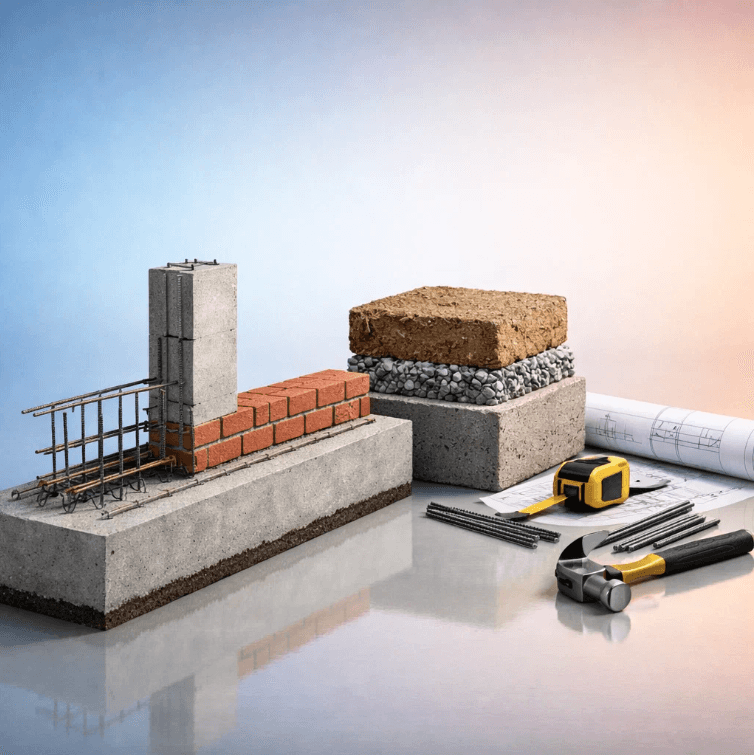
Strip Footing is a continuous strip of concrete that supports load-bearing walls by distributing the building load evenly along the soil. It is classified under shallow foundations and is ideal for structures where loads are linear rather than concentrated.
Key Features
- Spreads load across a long, continuous area
- Used for load-bearing walls, not columns
- Suitable for soils with good bearing capacity
- Requires simple construction techniques
- Popular in residential and low-rise buildings
Types of Strip Footing (With Simple Definitions)
Understanding the types of strip footing helps in selecting the right foundation for soil type, load conditions, and building design.
1. Plain Concrete Strip Footing
A simple strip of plain concrete without reinforcement.
Best for: Light loads and uniform soil conditions.
2. Reinforced Strip Footing
Includes reinforcement bars to handle higher bending and shear forces.
Best for: Heavier buildings or weak soil.
3. Stepped Strip Footing
Constructed in steps to compensate for sloping ground or uneven soil.
Best for: Hilly terrains and areas with level differences.
4. Deep Strip Footing
Used when the foundation must be placed deeper to reach stronger strata.
Best for: Sites with weak topsoil or high moisture content.
Comparison Table: Strip Footing vs Isolated Footing (Snippet-Ready)
| Feature | Strip Footing | Isolated Footing |
| Load Type | Supports load-bearing walls | Supports individual columns |
| Construction Cost | Lower | Higher for multiple footings |
| Soil Requirement | Requires uniform soil | Can handle varied soil |
| Reinforcement | Optional/Required based on load | Always required |
| Use Case | Residential buildings, boundary walls | Multi-storey buildings |
Advantages of Strip Footing
Strip footings are widely preferred because they strike the right balance between strength, simplicity, and cost.
- Cost-Effective Foundation
- Lower material cost
- Less excavation compared to raft foundations
- Ideal for residential building footing
- Easy to Construct
- Simple layout
- Fast execution
- Suitable for small contractors and local construction teams
- Good Load Distribution
- Distributes load uniformly across the strip
- Works well with load-bearing wall foundations
- Highly Compatible with Different Soil Conditions
- Especially effective in moderately strong soils
- Can be adapted (reinforced or stepped) for weak or sloping soils
Limitations of Strip Footing
Though efficient, strip footings are not suitable for every project.
1. Not Suitable for High-Rise Buildings
Their load-carrying capacity is limited compared to deep foundations.
2. Requires Uniform Soil
Uneven or loose soil may cause differential settlement.
3. Wider Footing Needed in Weak Soil
This increases concrete usage and cost.
4. Vulnerable to Waterlogging
Not recommended for waterlogged or marshy areas without special treatment.
Soil Conditions Required for Strip Footing
Choosing the right soil ensures foundation stability.
Ideal Conditions
- Low moisture content
- Bearing capacity above 100 kN/m²
- Minimal clay or organic material
- Stable ground with low settlement risk
Not Ideal For
- Loose sand
- Expansive clay
- High groundwater table
Depth and Reinforcement in Strip Footing
- Typical depth of strip footing: 0.6 m to 1.5 m, depending on soil.
- Reinforcement is added based on load calculation to resist bending and shear.
- In seismic zones (like North Bengal), reinforcement becomes essential.
Construction Process of Strip Foundation (Step-by-Step List)
- Soil investigation
- Marking and layout
- Excavation
- Laying PCC (Plain Cement Concrete)
- Placing reinforcement (if required)
- Shuttering
- Pouring concrete
- Curing and backfilling
Conclusion – Strip Footing: A Reliable Choice for Strong, Long-Lasting Foundations
Strip footing remains one of the most trusted and cost-effective foundation solutions, especially in rapidly developing regions like Siliguri. With the right soil assessment, reinforcement, and design, it ensures long-term structural stability.
CTA – Build on a Strong Foundation with the Right Experts
If you’re planning home construction in Siliguri, or need expert guidance on foundation design, load-bearing walls, or strip footing vs isolated footing,
👉 Consult our civil engineering experts at Elite Blueprints Consultancy today.
We ensure safe, economical, and durable foundations—built right from the ground up.
📞 Call Us Today: +91-82500 86323, +91-97497 48143
🌐 Visit: www.ebcsiliguri.com
📍 Based in Siliguri | Serving India
FAQs About Strip Footing
Is strip footing good for residential construction?
Yes. It is one of the most economical and reliable options for low-rise and residential buildings.
What is the cost of strip footing?
Cost varies based on depth, reinforcement, and soil conditions, but it is generally cheaper than raft or pile foundations.
When should I choose reinforced strip footing?
When soil is weak, building load is high, or seismic loads need consideration.
Read also: Key Design Features of Successful Commercial Building Plans
Read also: Global Steel Structural Standards and Best Practices 2026: An India-Centric Guide


Comments are closed