
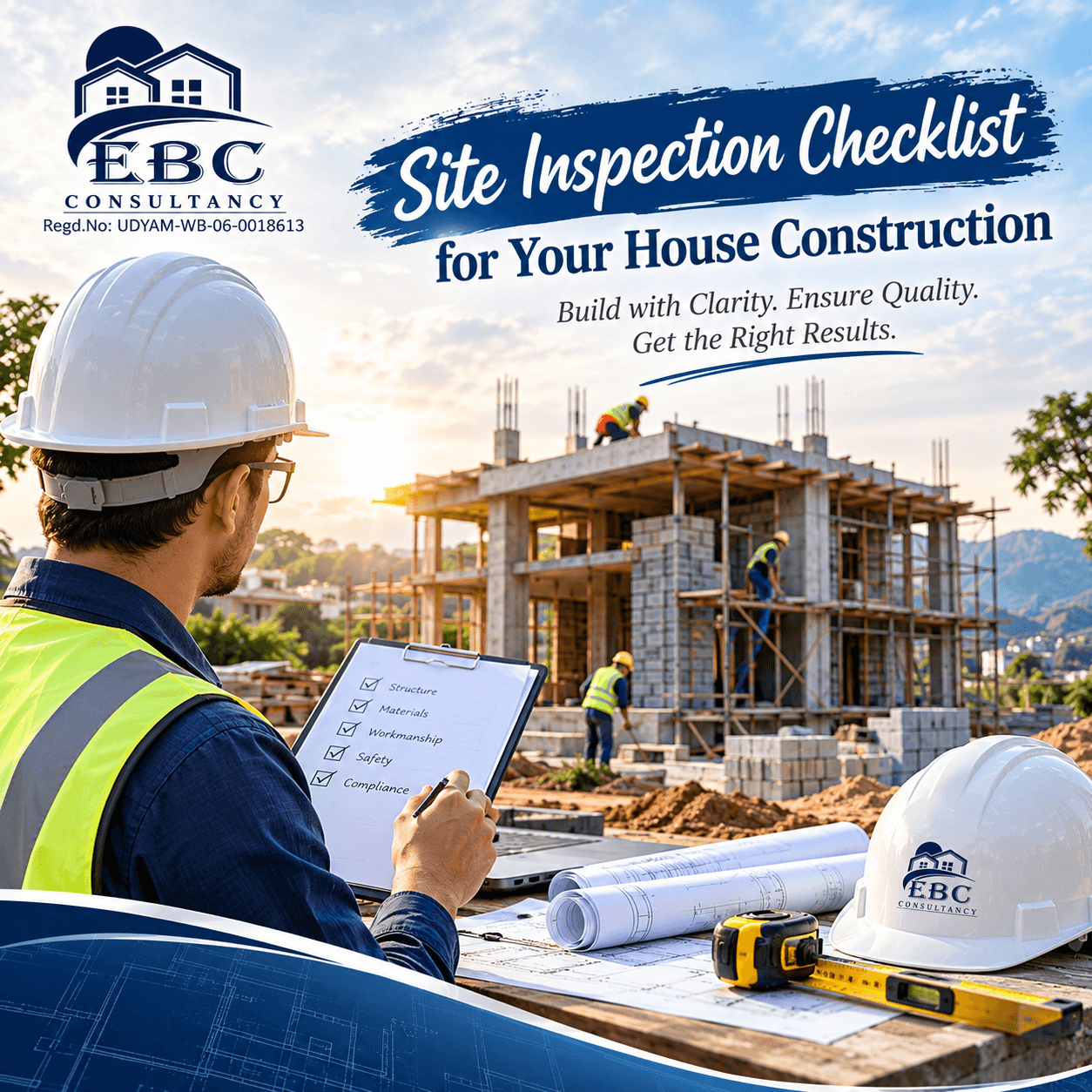
A practical guide for homeowners in Siliguri and nearby areas, covering seven critical construction stages—from excavation and foundations to finishing.
Why a Construction Site Inspection Checklist Matters
Constructing a house involves several stages where small mistakes can lead to expensive repairs, water leakage, structural defects, or finishing problems. A proper construction site inspection checklist helps homeowners verify that work follows approved drawings, project specifications, and the structural engineer’s instructions.
For homeowners in Siliguri and surrounding areas, regular inspections are particularly important for managing monsoon-related moisture, drainage, concrete quality, and construction workmanship.
Professional site supervision services in Siliguri can help monitor workmanship, identify deviations early, and document issues before they become difficult to correct. The Bureau of Indian Standards’ National Building Code provides a broader framework for building safety, construction practices, and quality management.
Here are the seven essential stages every homeowner should inspect.
Check before foundation concrete
Excavation Stage — Check Before Foundation Work
Excavation establishes the base for your entire structure. Errors at this stage can affect foundation stability and increase construction costs.
⚠ Hold point: Do not allow foundation concrete to be poured until the foundation level and soil conditions have been inspected.
Check before pouring
Footing Stage — Inspect Reinforcement and Concrete
Footings transfer building loads to the ground. Their dimensions, reinforcement, and concrete quality must follow the structural drawings.
Check during and after concreting
Column Stage — Verify Structural Safety
Columns carry loads from beams and slabs down to the foundations. Incorrect reinforcement or poor concreting can compromise structural performance.
Check before and after pouring
Slab Stage — Inspect Before and After Pouring
The slab inspection is one of the most important steps because many reinforcement and service-installation issues become difficult to access after concrete is poured.
Check while walls go up
Brickwork Stage — Check Alignment and Openings
Brickwork affects room dimensions, wall stability, and the quality of plastering and finishing.
Check before and after plastering
Plastering Stage — Prevent Cracks and Dampness
Plastering creates a smooth finish and protects wall surfaces. Poor surface preparation or curing can result in cracks, debonding, and uneven finishes.
Check before final payment
Finishing Stage — Inspect the Final Details
Finishing determines the building’s appearance, comfort, and everyday usability. Inspect each room before making final payments.
Professional Site Supervision vs. Unsupervised Construction
| Inspection factor | ✓ Professional supervision | ⚠ Without regular supervision |
|---|---|---|
| Drawing compliance | Systematic checks | Deviations may go unnoticed |
| Reinforcement | Checked before concreting | Errors may remain concealed |
| Material quality | Verified against specifications | Inconsistent quality risk |
| Workmanship | Defects documented early | Repairs may be expensive |
| Progress reporting | Inspection records maintained | Limited visibility |
How EBC Supports Your Construction Project
Elite Blueprints Consultancy provides architectural and engineering consultancy to help homeowners make informed decisions at every stage.
Our site supervision services in Siliguri can support:
1
Understand your project, drawings, and construction requirements.
2
Review agreed critical stages and identify visible deviations.
3
Communicate observations to the contractor and relevant engineer.
4
Record issues and track corrective actions.
5
Help identify outstanding defects before handover.
The inspection scope and frequency should be agreed upon in advance. Site visits do not replace required structural design, material testing, or statutory inspections.
Build with Confidence with EBC
A well-designed house needs careful execution at every stage. Using a construction site inspection checklist and engaging qualified professionals can help reduce avoidable defects, improve quality control, and protect your investment.
For architectural and engineering consultancy and site supervision services in Siliguri, contact Elite Blueprints Consultancy.
📞 +91-82500-86323, +91-97497-48143
🌐 www.ebcsiliguri.com


Comments are closed