
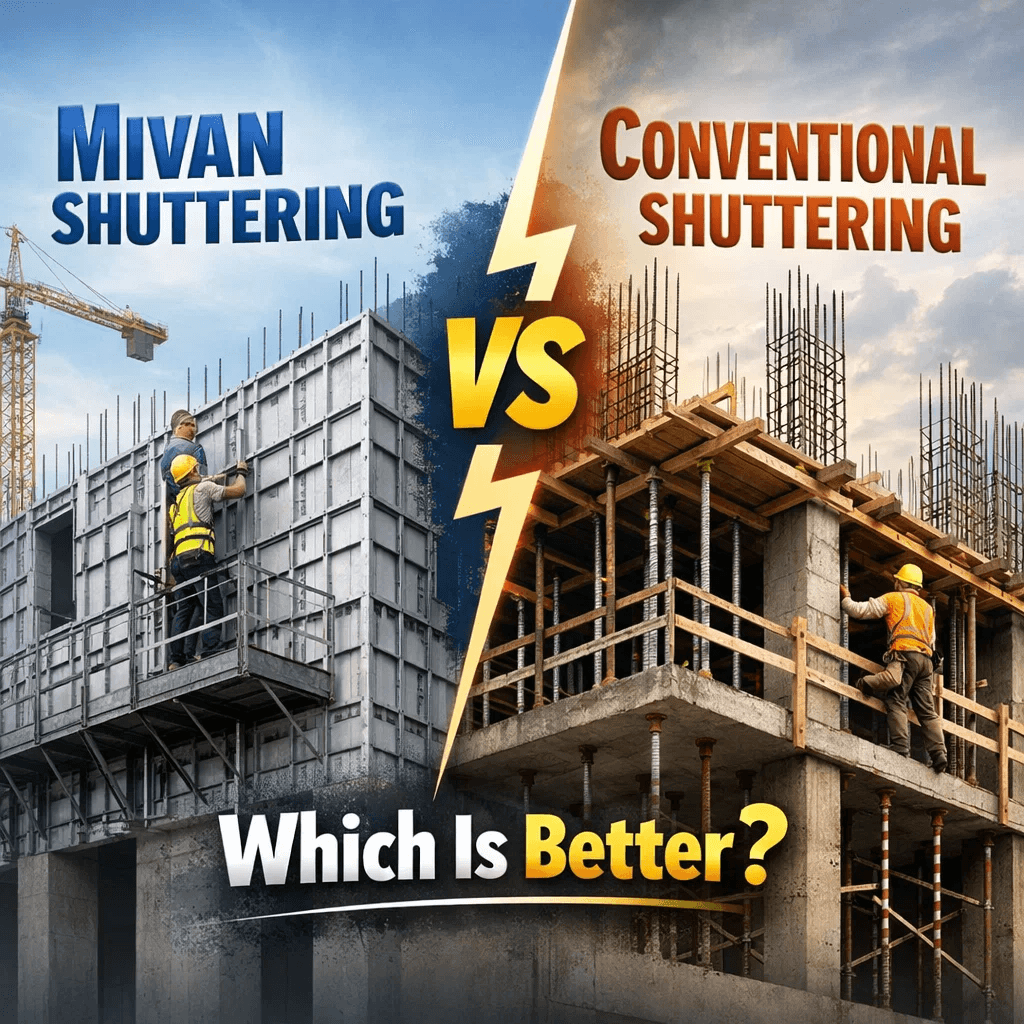
Why Shuttering Systems Are Evolving in Modern Construction
With rapid urbanization, rising labor costs, and demand for faster project delivery, the Indian construction industry is shifting toward modern shuttering techniques. Traditional methods are slowly being challenged by advanced systems like Mivan shuttering, especially in large-scale RCC projects.
Choosing the best shuttering system for RCC construction directly impacts:
- Construction speed
- Structural quality
- Overall project cost
- Long-term durability
This makes the comparison between Mivan shuttering vs conventional shuttering extremely important for builders, developers, and even individual homeowners.
What Is the Difference Between Mivan Shuttering and Conventional Shuttering?
Mivan shuttering is an aluminium formwork system designed for fast, repetitive RCC construction, while conventional shuttering uses timber or steel formwork and relies heavily on manual labor.
Basic Definition
| Type | Definition |
| Mivan Shuttering (Aluminium Formwork) | A precision-engineered aluminium formwork system that allows monolithic casting of walls, slabs, beams, and columns |
| Conventional Shuttering (Traditional Formwork) | Temporary formwork made of timber, plywood, or steel, assembled and dismantled manually |
This difference forms the base of Mivan formwork vs traditional formwork comparison.
Mivan Shuttering vs Conventional Shuttering: Technical Comparison
| Parameter | Mivan Shuttering | Conventional Shuttering |
| Material | Aluminium | Timber / Plywood / Steel |
| Construction Speed | Very fast | Moderate to slow |
| Finish Quality | Smooth, plaster-free | Requires plaster |
| Labor Dependency | Low | High |
| Repetition Suitability | Excellent | Limited |
| Accuracy & Alignment | High precision | Depends on workmanship |
| Reuse Cycle | 200–300 times | 20–40 times |
| Initial Cost | High | Low |
This table clearly highlights conventional shuttering vs aluminium shuttering differences.
Construction Time Comparison: Mivan vs Conventional
One of the biggest advantages of Mivan is speed.
Construction Cycle Comparison
- Mivan Shuttering
- Typical floor cycle: 7–10 days
- Walls, slab, and columns cast together
- Conventional Shuttering
- Typical floor cycle: 20–25 days
- Sequential casting (columns → beams → slab)
Result:
For large housing projects, Mivan can reduce construction time by 40–50%, making it ideal for mass housing.
Mivan Shuttering Advantages and Disadvantages
Advantages of Mivan Shuttering
- Faster project completion
- Uniform structural quality
- Earthquake-resistant monolithic RCC structure
- Minimal plaster work required
- Reduced material wastage
- Better dimensional accuracy
These make it one of the best shuttering systems for RCC construction in high-rise and repetitive projects.
Disadvantages of Mivan Shuttering
- High initial investment
- Design changes after fabrication are difficult
- Not economical for small, irregular projects
- Requires skilled planning and execution
This is why Mivan shuttering for residential buildings is usually limited to apartments and large villas rather than individual small houses.
Is Conventional Shuttering Still Relevant?
Yes — conventional shuttering is still widely used in India, especially for:
- Individual residential houses
- Low-rise buildings
- Projects with frequent design changes
- Budget-sensitive constructions
Advantages of Conventional Shuttering
- Low initial cost
- Easy customization on site
- Suitable for complex architectural shapes
- Readily available materials and labor
For many builders, it remains a cost-effective shuttering system when speed is not the top priority.
Mivan Shuttering Cost in India
Approximate Cost Breakdown
| Item | Cost Range |
| Mivan Shuttering | ₹2,000 – ₹3,000 per sq.m (effective cost after reuse) |
| Conventional Shuttering | ₹800 – ₹1,200 per sq.m |
Important Note:
While Mivan shuttering cost in India appears higher initially, its reusability and speed often reduce the overall project cost in large-scale developments.
Which Is the Best Shuttering System for RCC Construction?
Choose Mivan Shuttering if:
- Project is large-scale or repetitive
- Speed and consistency are critical
- Long-term durability is a priority
Choose Conventional Shuttering if:
- Project is small or custom-designed
- Budget constraints exist
- Flexibility is more important than speed
There is no universal winner — the choice depends on project size, budget, and timelines.
Conclusion: Making the Right Choice for Your Project
The debate between Mivan shuttering vs conventional shuttering is not about which system is superior — it’s about which system suits your project best.
- Mivan offers speed, quality, and structural strength
- Conventional shuttering offers flexibility and affordability
Understanding construction time comparison (Mivan vs conventional), cost implications, and project scale will help you make an informed decision.
Need Expert Guidance on the Right Shuttering System?
At Elite Blueprints Consultancy, we help you choose the most cost-effective and technically sound shuttering system based on your project size, budget, and timeline.
📞 Call Us Today: +91-82500 86323, +91-97497 48143
🌐 Visit: www.ebcsiliguri.com
📍 Based in Siliguri | Serving India
Build smarter. Build faster. Build right.
FAQs: Mivan Shuttering vs Conventional Shuttering
Q1: Is Mivan shuttering suitable for independent houses?
Not usually. It is more economical for apartments and mass housing projects.
Q2: Which is more durable — Mivan or conventional?
Mivan creates a monolithic RCC structure, making it more durable and earthquake-resistant.
Q3: Is Mivan shuttering a modern technique in India?
Yes. It is among the most widely adopted modern shuttering techniques in India for large developments.
Read also: G+1, G+2, or G+3: What Is Ideal for Your Plot Size?


Comments are closed